Defining your market boundaries is one of the most important exercises an entrepreneur can undertake. It clarifies where your business operates effectively, highlights growth opportunities, and helps allocate resources wisely. By visualizing your market boundaries, you can make strategic decisions based on data and insights rather than guesswork.
This article walks you through a hands-on exercise to map your market boundaries using a step-by-step approach.
Why Market Boundary Mapping Matters
Mapping your market boundaries provides clarity in three key areas:
- Focus:
- Identify the core areas where your business thrives.
- Example: A meal-kit delivery service focuses on urban regions with dense populations for efficient distribution.
- Opportunity:
- Highlight adjacent markets and potential growth areas.
- Example: A fitness app targeting individuals explores opportunities in corporate wellness programs.
- Flexibility:
- Prepare for boundary shifts caused by evolving customer needs, technology, or competition.
- Example: A cloud storage provider adapts to serve healthcare clients by meeting industry-specific compliance standards.
Step-by-Step Market Boundary Mapping Exercise
Step 1: Draw Your Market Circles
Visualize your market in three concentric circles to define your current and potential boundaries:
- Inner Circle: What you do today.
- Middle Circle: What you could easily expand to.
- Outer Circle: What’s possible but requires significant changes.
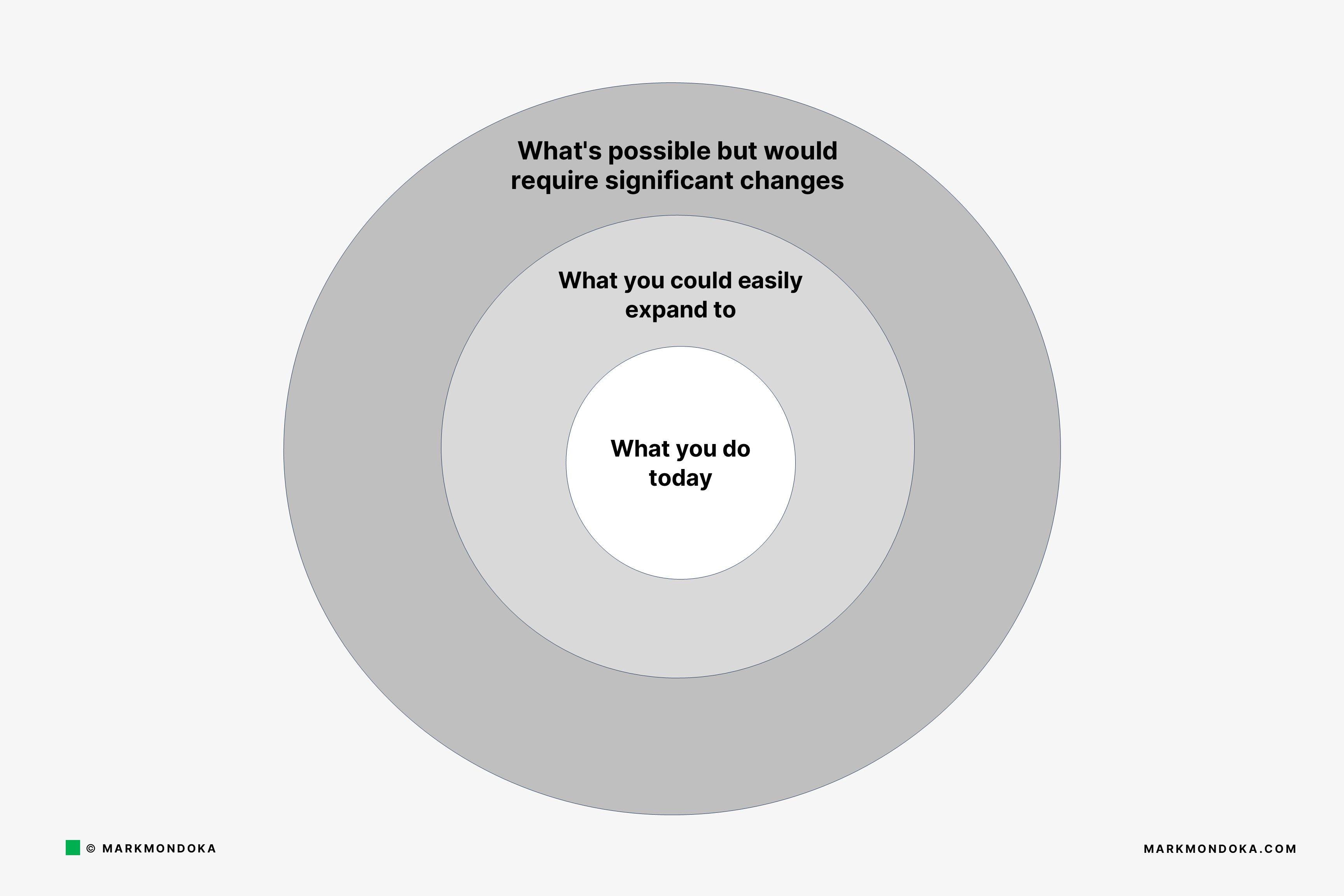
Example:
- Inner Circle: A meal-kit service delivering within a 50-mile radius.
- Middle Circle: Expansion to neighboring states with minor logistical upgrades.
- Outer Circle: Nationwide delivery requiring major infrastructure investments.
Step 2: Define Key Components for Each Circle
For each circle, answer the following questions:
- Customer Needs:
- What specific needs are you solving in this boundary?
- Example: Inner Circle customers need quick, healthy meals. Middle Circle customers may also need custom meal options (e.g., vegan or gluten-free).
- Capabilities:
- What technology, skills, or resources enable this boundary?
- Example: Inner Circle relies on a local kitchen and delivery fleet. Expanding to the Middle Circle may require partnerships with regional food suppliers.
- Competitors:
- Who are your competitors in this boundary, and how are they positioned?
- Example: Competitors in the Inner Circle include local meal-prep companies, while Middle Circle competitors include larger regional delivery services.
- Resources:
- What financial, human, or physical resources are needed to operate in this boundary?
- Example: Middle Circle expansion may need additional delivery staff and a marketing budget for customer acquisition.
- Regulations:
- Are there legal or regulatory considerations for this boundary?
- Example: Expanding to the Outer Circle may require compliance with food safety laws in different states.
Step 3: Map Adjacent Opportunities
Look beyond your core market to identify adjacent opportunities within reach.
- Primary Opportunities:
- Opportunities closely aligned with your current market.
- Example: A subscription box company for beauty products expands to wellness products like vitamins and skincare.
- Adjacent Opportunities:
- Markets that require slight adjustments but leverage your existing strengths.
- Example: A fitness app that provides workout plans adds nutrition tracking as a complementary service.
- Emerging Opportunities:
- Future possibilities tied to trends or evolving customer needs.
- Example: An e-commerce platform integrates AI-powered personal shopping assistants to stay ahead in the digital retail space.
Step 4: Test Your Boundaries
Evaluate whether the boundaries you’ve defined are realistic and actionable.
Questions to Ask:
- Is this boundary defensible?
- Can you maintain a competitive advantage within this market?
- Is it profitable?
- Do the potential revenues outweigh the costs of operating in this market?
- Is it sustainable?
- Can you consistently serve this market without overextending resources?
- Is it expandable?
- Does this boundary offer pathways to future growth?
Example:
- Middle Circle expansion into neighboring states may be defensible due to regional brand recognition, profitable with efficient logistics, sustainable if resources are optimized, and expandable to national reach.
Step 5: Create a Market Boundary Playbook
Document your findings to guide future decision-making and adjustments.
Sections to Include:
- Core Markets:
- Summarize your Inner Circle and what makes it successful.
- Expansion Plans:
- Outline strategies for Middle and Outer Circle growth.
- Triggers for Adjustment:
- Identify signals that suggest it’s time to adjust boundaries, such as customer demand, competitor actions, or new technology.
Example: Market Boundary Map for a Fitness App
Inner Circle: Current Market
- Customer Needs: Personalized workout plans for individuals.
- Capabilities: App with AI-powered plan generation and activity tracking.
- Competitors: Other fitness apps focused on general audiences.
- Resources: Existing tech infrastructure and customer support team.
- Regulations: Basic app store guidelines and data privacy laws.
Middle Circle: Easy Expansion
- Customer Needs: Nutrition guidance and meal planning.
- Capabilities: Add a nutrition tracking module and partner with recipe providers.
- Competitors: Apps offering holistic fitness solutions.
- Resources: Minimal development costs and marketing campaigns for existing users.
- Regulations: Compliance with food labeling laws if integrating meal recommendations.
Outer Circle: Long-Term Potential
- Customer Needs: Comprehensive health management, including mental wellness.
- Capabilities: Partnerships with healthcare providers and mindfulness experts.
- Competitors: Healthcare-focused apps and telemedicine platforms.
- Resources: Significant investment in partnerships and regulatory approvals.
- Regulations: HIPAA compliance for health data management.
Common Pitfalls to Avoid
- Overestimating Potential:
- Expanding too quickly without testing feasibility.
- Solution: Pilot expansion efforts in the Middle Circle before committing to Outer Circle initiatives.
- Underestimating Costs:
- Ignoring the full financial impact of expansion.
- Solution: Develop detailed cost estimates and contingency budgets.
- Ignoring Feedback:
- Neglecting customer input when defining market boundaries.
- Solution: Incorporate customer surveys and focus groups into your mapping process.
Conclusion
Mapping your market boundaries helps you focus on where your business thrives today while planning for strategic growth tomorrow. By understanding your Inner, Middle, and Outer Circles, you can prioritize opportunities, allocate resources wisely, and make data-driven decisions.
Next Steps
- Draw your three concentric market circles.
- Define the customer needs, capabilities, competitors, resources, and regulations for each circle.
- Validate your boundaries using the questions provided and document your findings in a playbook.
In the next article, we’ll explore Dynamic Boundaries: Adapting to Change in Evolving Markets, discussing how to adjust your boundaries as conditions shift.
Taking the time to map your boundaries now sets the stage for focused, sustainable growth in the future. Start mapping today!

Leave a reply to Leveraging Resources for Market Expansion: Unlocking Growth Potential – Mark Mondoka Cancel reply